
For licensed Ontario real estate professionals
From your client’s address to a decision you can defend.
The same sequence a professional underwriter follows, applied identically to every property you analyze — so two agents on your team reach comparable numbers on the same building.
- Every assumption visible and editable
- Ontario tax classes and by-laws cited
- Deterministic maths kept separate from AI interpretation
- Client-branded report at the end
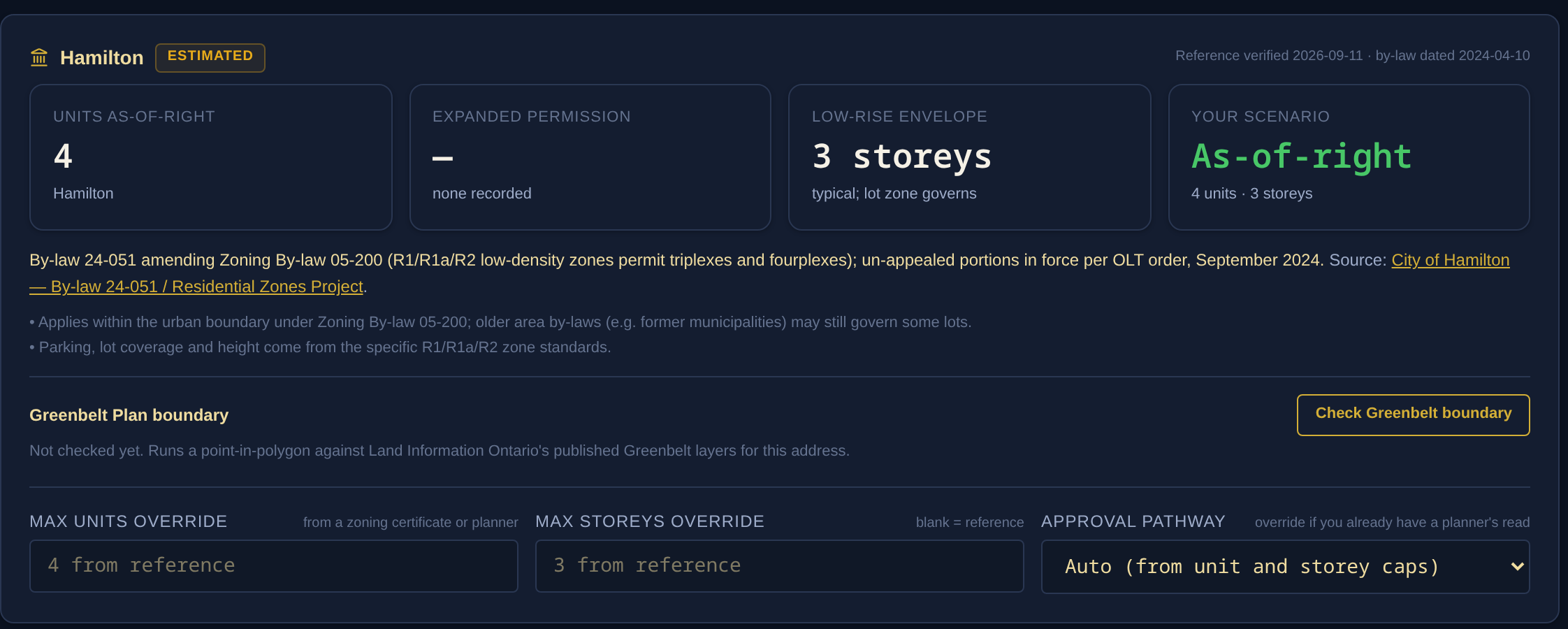
STEP 01
Enter the property
Start with an address, paste your client's listing, or type your own numbers. You can override any input — the model never hides an assumption from you or your client.
- Address, pasted listing or manual entry
- Optional document upload
- Your client's financing terms
Enter the property
SampleLease — Unit 1.pdf ExtractedRent roll 2026.xlsx ExtractedProperty tax bill.pdf ExtractedDocument-sourced figures are the highest confidence tier in the model.
STEP 02
Research assembled for you
Property, market, neighbourhood and municipal context are assembled into a structured brief, with every figure labelled document-sourced, data-sourced or modelled — and left empty where no legitimate source exists.
- Municipal tax class and rate with verification date
- Zoning by-law cited, dated and linked
- CMHC / Statistics Canada rent benchmarks, aggregate and dated
Research assembled for you
Sample142 Sample St · 0.4 km$718,00088 Example Ave · 0.7 km$742,5007 Placeholder Rd · 1.1 km$705,000Adjusted average$729,000Worked sample only. Live MLS data is not connected; use verified comps from your agent.
STEP 03
Underwrite line by line
A full expense build produces NOI, then Canadian financing, valuation and returns: cap rate, cash flow, DSCR, cash-on-cash, IRR and ROI — with vacancy and capital reserves included, not assumed away.
- Semi-annual compounding on Canadian mortgages
- Three valuation approaches reconciled to a range
- Ontario and Toronto land transfer tax, CMHC premiums where insured
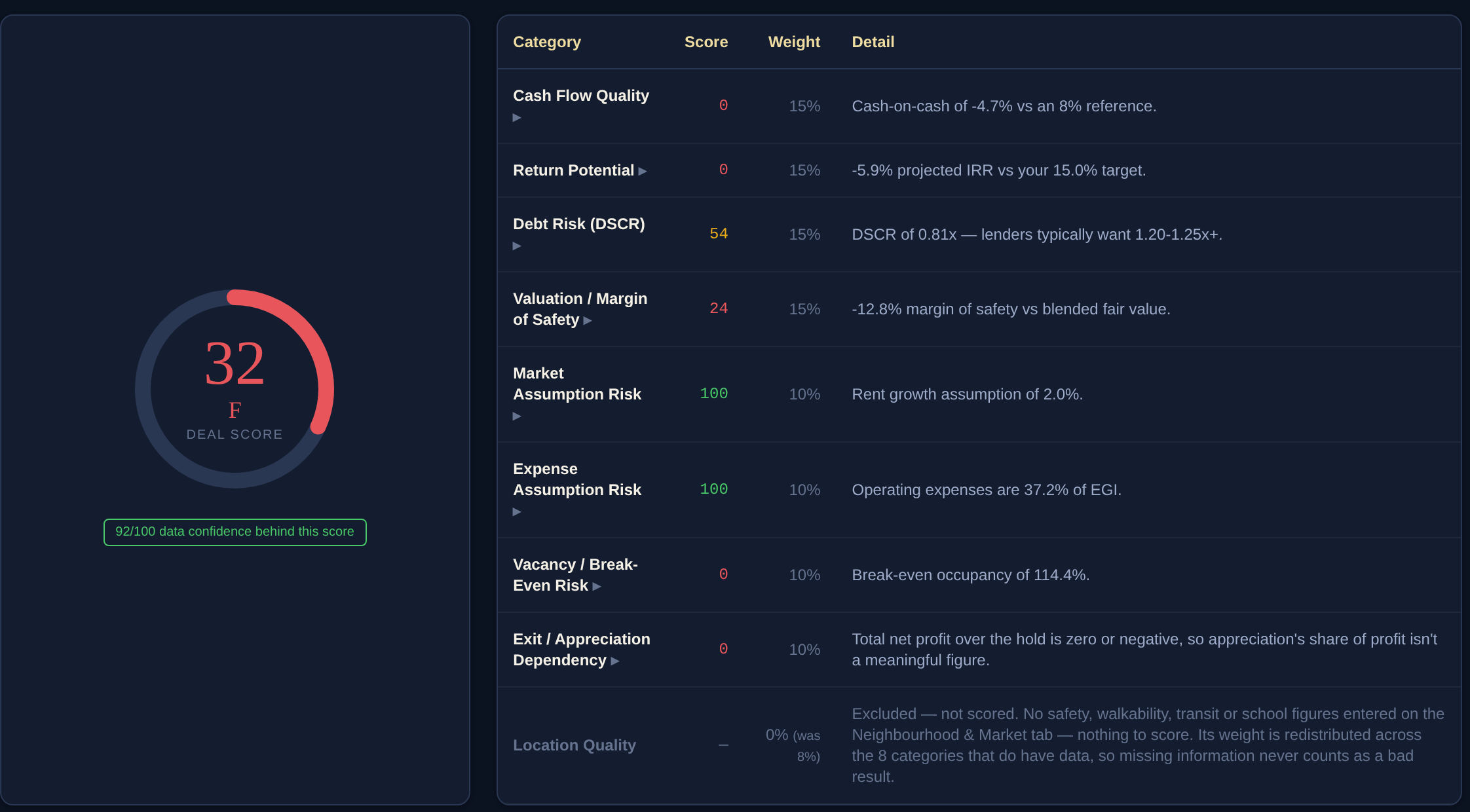
Actual PropertyEdge screen: the Deal Score breakdown with each component's contribution shown. Sample property, real reference data. STEP 04
Stress test before your client does
Bull, base, bear and worst-case scenarios move rent, vacancy, expenses, interest rates and exit value, then Monte Carlo shows the distribution — so you know which single input breaks the deal first.
- Four standard scenarios
- Break-even threshold per input
- Renewal rate sensitivity
Stress test before your client does
SampleBull · DSCR1.62Base · DSCR1.42Bear · DSCR1.18Worst · DSCR0.97STEP 05
Hand over one document
Executive summary, valuation range, maximum offer with its binding constraint, ranked risks with dollar impact and a BUY / NEGOTIATE / PASS verdict with its reasoning written out — print-ready or as a private share link, branded to you.
- Client-branded PDF or share link
- Risk register with severity and dollar impact
- Written rationale your client can challenge
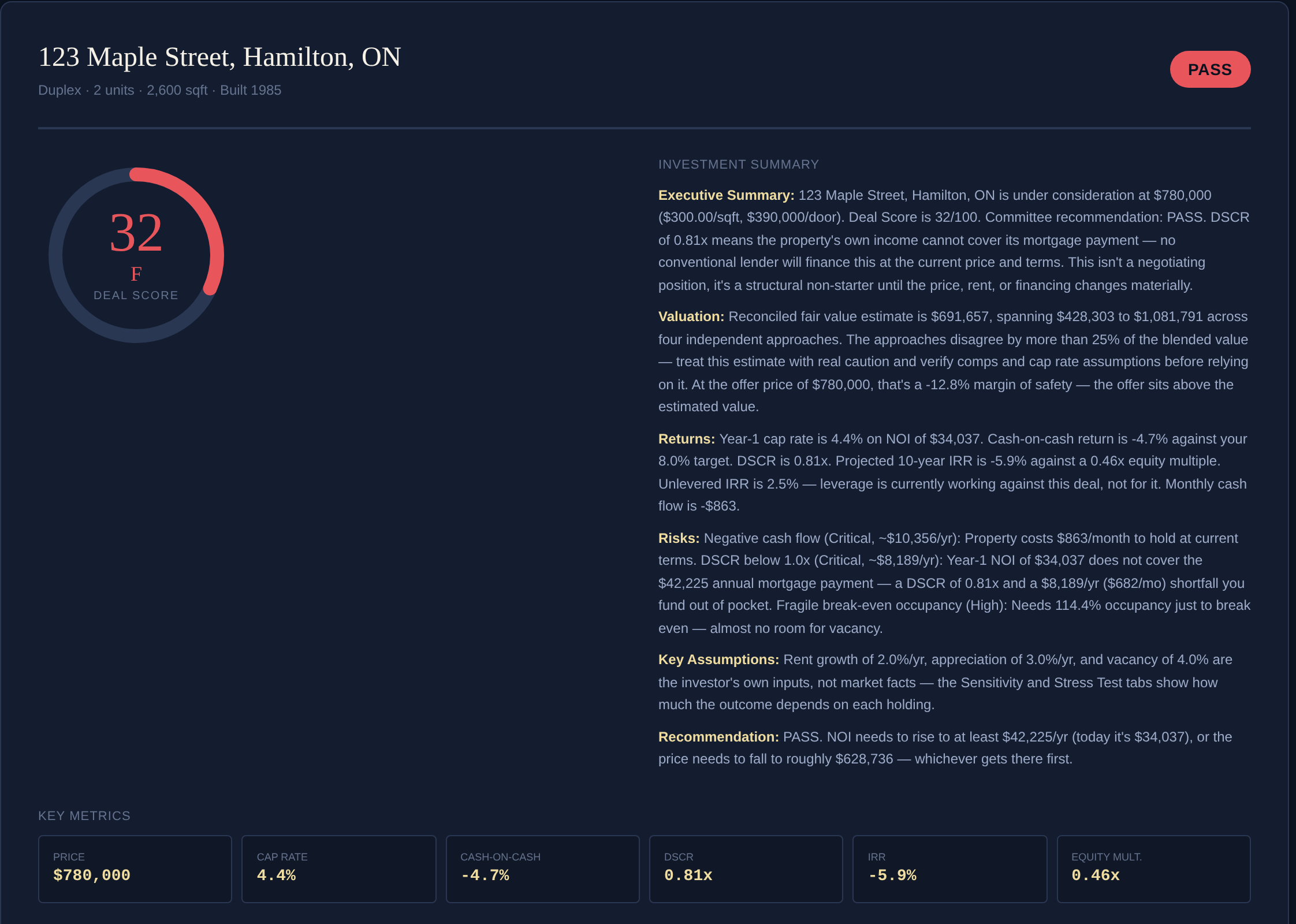
The client deliverable: create client link, copy as text, or print to PDF.
After the closing
The step other tools skip.
- Watchlists and alerts
- New matches against your client's criteria, with instant SMS on watchlist hits.
- Market digests
- Periodic branded summaries built only from data that is genuinely available.
- Actual vs Projected
- Real post-closing performance measured against the projection you presented.
Analyze your next investor listing.
Free to start, no credit card. See the analysis before you create an account.
PropertyEdge provides analysis and estimates for informational purposes only. It is not investment, tax, legal or appraisal advice, and no return or investment outcome is guaranteed. Estimates are modelled from the assumptions shown and must be verified against leases, inspections, tax bills and municipal records before you make an offer.